ATPL Performance: Level Flight, Range, and Endurance
Specific Range (SR) vs. Specific Endurance (SE)
Performance planning focuses on efficiency: how much distance or time can be gained per unit of fuel.
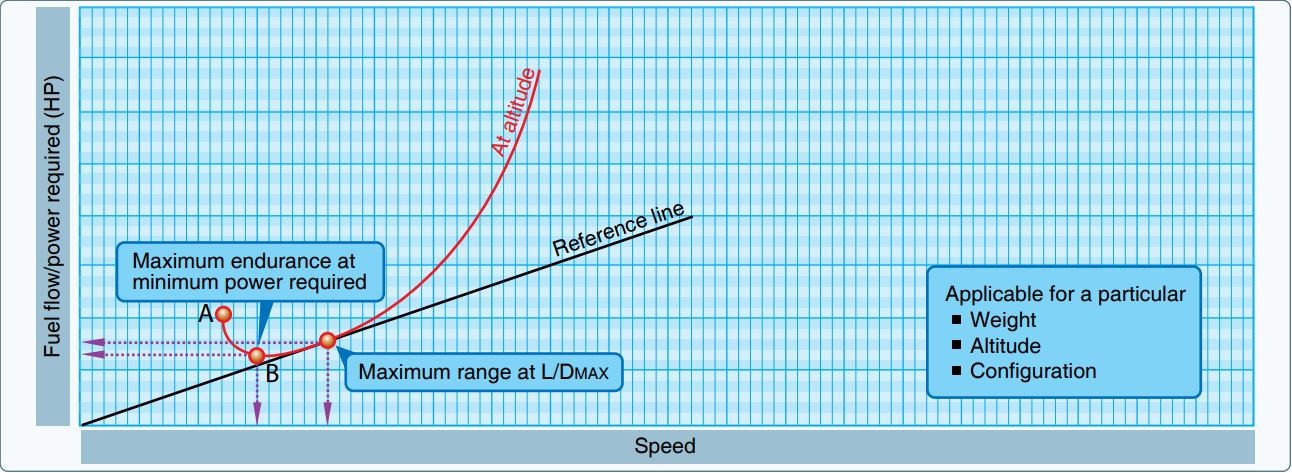
Specific Range (SR)
- Definition: Distance flown per unit of fuel. $ SR = \frac{\text{True Airspeed (TAS)}}{\text{Fuel Flow (FF)}} $
- Goal: Max Range (flying as far as possible).
- Aerodynamic Condition:
- Jet: Fly at $1.32 V_{MD}$ (approx). Optimized where the ratio $TAS/Drag$ is maximum.
- Prop: Fly at $V_{MD}$. Optimized where $Drag$ is minimum.
Specific Endurance (SE)
- Definition: Flight time per unit of fuel. $ SE = \frac{1}{\text{Fuel Flow}} $
- Goal: Max Endurance (staying airborne as long as possible, e.g., Holding).
- Aerodynamic Condition:
- Jet: Fly at $V_{MD}$. Minimum Thrust required = Minimum Fuel Flow.
- Prop: Fly at $V_{mp}$ (Minimum Power Speed). Minimum Power = Minimum Fuel Flow.
Effect of Variables
Wind
- Range: Tailwind increases Ground Speed, increasing Range. Headwind decreases Range.
- Pilot Action: In a headwind, increase speed slightly (Cost Index increases) to penetrate the wind. In a tailwind, decrease speed to stay in the wind longer.
- Endurance: Wind has no effect on Endurance (time aloft depends only on fuel flow, not ground distance covered).
Mass (Weight)
- Range: Higher mass requires higher Lift ($L=W$), creating more Induced Drag. More thrust/fuel is needed. Range decreases.
- Speed: As weight decreases (fuel burn), the optimum range speed decreases.
- Endurance: Higher mass requires more power/thrust to maintain altitude. Endurance decreases.
Altitude
- Jet Range: generally increases with altitude due to lower temperature (better engine efficiency) and higher TAS for the same IAS.
- Prop Range: less affected by altitude, limited by engine performance drop-off.