Development of precipitation
 Schematic diagram of the water cycle and precipitation types.
There are two main theories explaining the formation of precipitation droplets: the Bergeron Theory and the Coalescence Process.
Bergeron Theory (Ice Crystal Process)
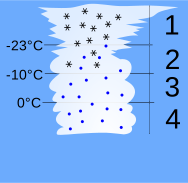
This process is the dominant mechanism for precipitation formation in mid and high latitudes.
- Environment: Occurs in mixed clouds containing both supercooled water droplets and ice crystals (temperatures below 0°C).
- Physical Principle: The saturation vapor pressure over liquid water is greater than over ice at the same temperature.
- Mechanism:
- A water vapor gradient exists from the droplets towards the crystals.
- Water evaporates from the liquid droplets and deposits (sublimation) onto the ice crystals.
- The ice crystals grow at the expense of the water droplets.
- As they grow, they become heavy enough to fall.
- Result: Precipitation starts as snow. Depending on the temperature of the lower layers, it may reach the ground as snow or melt and fall as rain.
Coalescence Process (Collision-Coalescence)
This process is typical of warm clouds (tops warmer than -15°C) and is the main mechanism in the tropics.
- Mechanism:
- Cloud droplets have different sizes and, therefore, different terminal fall speeds.
- Larger droplets fall faster, colliding with smaller droplets in their path.
- If the collision overcomes surface tension, the droplets merge (coalescence), forming a larger droplet.
- Result in Mid-Latitudes: Generally produces only drizzle or very light rain, because warm clouds have less vertical extent and convective currents break up large drops.
Hail Formation
Hail is exclusively associated with Cumulonimbus (Cb) clouds due to their strong vertical currents.
- Requirements:
- Strong updrafts and downdrafts.
- Abundance of supercooled water.
- Growth:
- Ice particles circulate within the cloud, rising and falling repeatedly.
- They grow by aggregation upon colliding with supercooled water droplets that freeze on impact (accretion), and also by sublimation.
- This cycle creates a layered structure (like an onion).
- Fall: They fall to the ground when their weight exceeds the force of the updraft. They are considered hailstones when they exceed 5 mm in diameter.